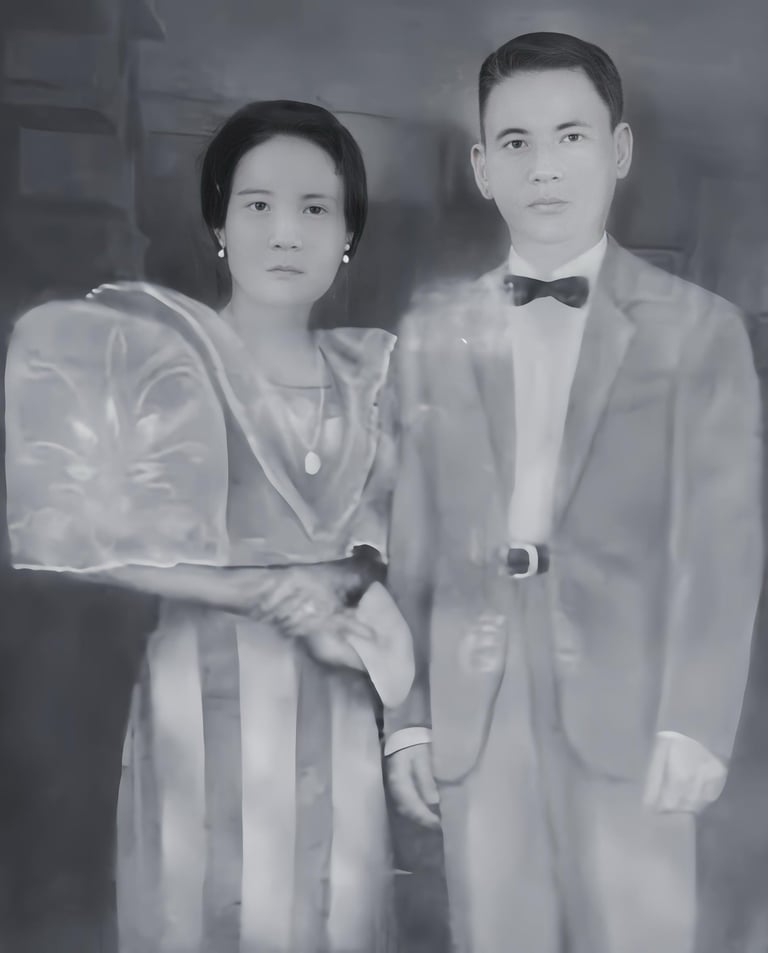
Punong Ginoong Gorgonio with Punong Ginang Cleotilde
Punong Ginoong Gorgonio Chávez Contreras (1885–1969) was a direct descendant of the Maginoo of Bulalacao (Mait), inheriting a lineage whose authority predated the Spanish conquest. Raised within the traditions of the Principalia, he grew up at a time of enormous transformation, born under the final decades of Spanish colonial rule and coming of age during the American colonial era. Through these shifting political worlds, he remained a steadfast embodiment of the customs, discipline, and dignity expected of a Maginoo.
Deeply respected throughout Bulalacao and throughout Mindoro, Punong Ginoong Gorgonio was regarded as an arbiter of disputes and a person of unquestioned integrity. Community members sought his judgment because he upheld the old codes of conduct: strict, principled, rooted in honor, and insisted that all matters be resolved in a way that preserved harmony, fairness, and ancestral values. During the Japanese Occupation, Punong Ginoong Gorgonio was instrumental in resistance efforts and protecting the people of Mindoro. He would lose his daughter in law, Punong Ginang Carolina, wife of his son, Punong Ginong Eusebio, during the war. In addition, his son-in-law, Punong Ginoong Abelardo, husband to his daughter, Punong Ginang Amada, would be captured by the Japanese and would walk the Bataan Death March.
Punong Ginoong Gorgonio Chávez Contreras is remembered as a leader and guardian of his people, a preserver of Maginoo tradition, customs, discipline and a man whose courage and dignity sheltered an entire community in its darkest hour.